Control stations, pumps, telemetry and inline measurement — selection to the well regime and supply to order.
longest recorded run life
1,808*days
average production gain across the portfolio
+26.6*%
run life downhole with scale protection
~900*days
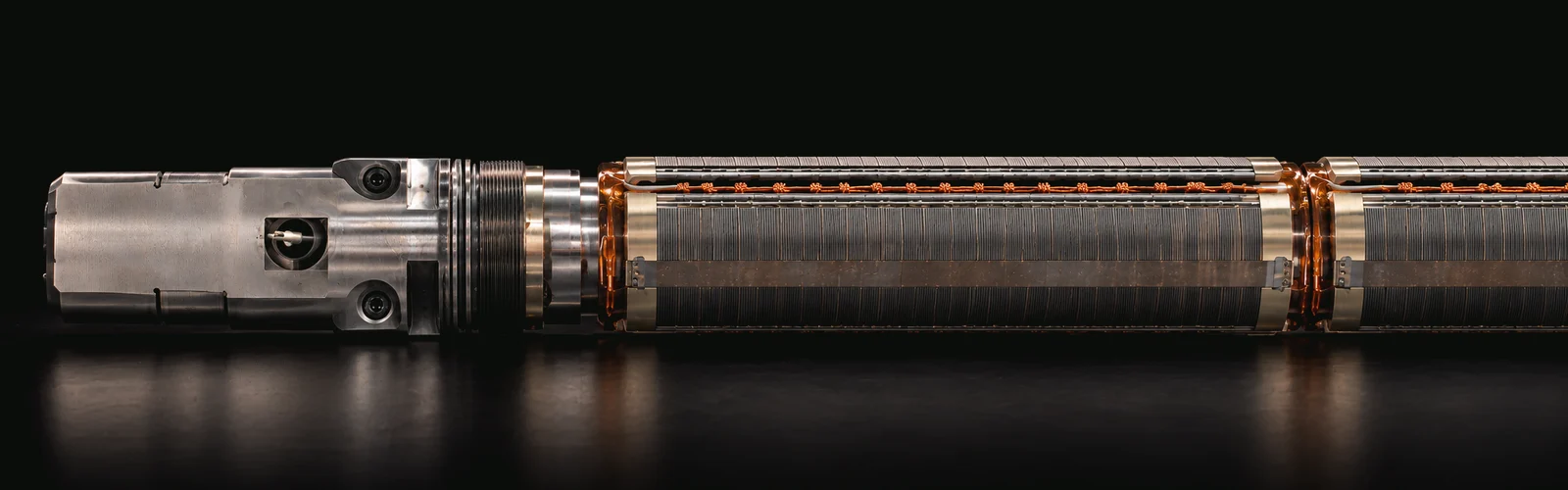
Concept visualisation
Field challenges
Select a challenge — the matching equipment opens
Eight equipment directions.
Artificial lift, pumping systems, downhole equipment protection, surface control, telemetry, simultaneous separate production, modular process packages and inline water-cut measurement.
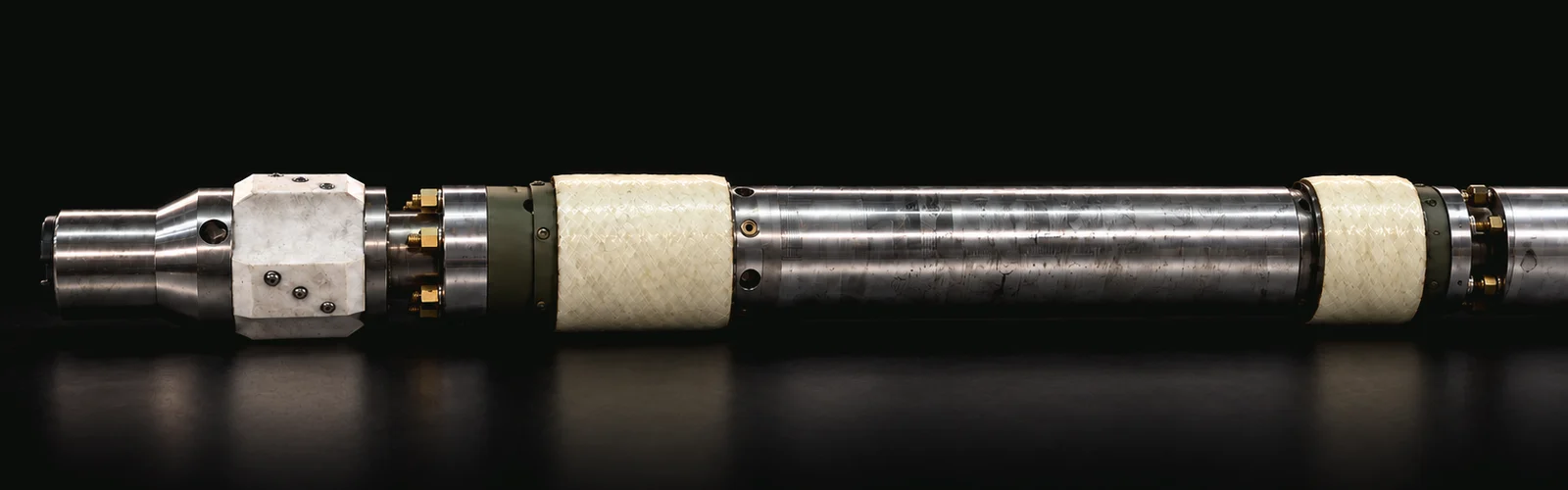
Anatomy / plunger unitVisualisation
Sucker-rod-less plunger system with a linear motor
Takes on well stock where a rod string runs into wellbore curvature, rod failures and tubing wear.
A rod-free pumping system for low-rate, inclined and highly deviated wells. A downhole drive removes the rod string and its operating constraints.
Low-rate well stock
Deviated wellbore
Rod-string free
1–43
m³/day
≤ 2 800
depth, m
≤ 70°
deviation
* Marked figures come from internal technical materials and are refined in the assessment for each asset.
The technology has run time behind it.
Below are operating figures from internal field statistics. These are not datasheet ranges — they are what the equipment has already accumulated in service. For your asset, every figure is recalculated in the assessment.
SPLM
Sucker-rod-less plunger system with a linear motor
MeasureValue
Units in service
31*as of Dec 2025
Longest recorded run life
1,808*days
Average production gain across the fleet
+26.6*%
Reduction in specific energy consumption
18–68*%
RVC
Chemical-free scale mitigation
MeasureValue
Installations
1,500+*as of Dec 2025
Scale groups addressed
5*groups
Average run life of downhole equipmentdays
With the RVC system~900*
Without it320–440*
* Figures come from internal field-operation statistics. They have not been independently verified, and no public case study with a disclosed client and asset has been released. These results do not transfer automatically to another well stock: application fit and the expected outcome for a specific asset are established in the assessment.
A rotary steerable system you own. The service is on us.
HTD supplies D-Tech rotary steerable systems into the ownership of an operator or a service company and takes on everything else: repair and maintenance at the Aktobe base, spare part supply, training for your directional drillers and MWD engineers, and drilling support. The range covers hole sizes from 5 7/8" to 18 1/8", working temperature up to 150 °C and pressure up to 137.9 MPa.
Authorised distributor of D-Tech rotary steerable systems in the Caspian region since 2022
A preliminary package needs only the well profile, the mud type and density, and the flow rate range.
What the direction covers
Equipment you own
D-Tech RST rotary steerable systems and MWD telemetry, with spares supplied to the scope of your drilling programme. The tool stays with you: your schedule no longer waits on a service contractor queue.
Repair and maintenance in the region
A service base in Aktobe. After every run: full teardown and inspection with photographic records of each part, memory download, and a written report analysing the drilling parameters.
Training for your crew
Preparing the operator’s directional drillers and MWD engineers to run their own tool. A service centre on your own site and partial local assembly are worked out separately.
24/7 drilling support
Remote monitoring of active rigs, parameter review, BHA and hydraulics optimisation. Downlink by flow rate through the mud logging unit, real-time exchange with MWD: inclination, azimuth, collar rotation, shock levels.
Two ways to work
Equipment you own
You buy the RSS and spares to the scope of your drilling programme.
You sign a contract for repair, maintenance and spare part supply.
Your specialists are trained and run their own tool.
Optional: a service centre at your base, partial local assembly.
For whomCompanies with a standing horizontal drilling programme, where rented service has become the main cost line.
Drilling with our tool
HTD comes to the rig with its own equipment and directional drillers.
Work follows your drilling programme; the crew is set by the well profile.
Suits a trial before purchase, or one-off sections.
For whomThose who want to prove the tool on their own well before committing to a purchase.
Equipment
The D-Tech RST range
One platform covers the whole diameter range, from a sidetrack to a conductor section.
The D-Tech RST range
Size
Hole size, inches (mm)
Flow rate, l/min
RST475
5 7/8 – 6 5/8 (149.2 – 165.1)
643 – 1,514
RST500
6 3/4 (171.5)
643 – 1,514
RST650
7 7/8 (200.0)
1,135 – 2,540
RST675
8 1/2 – 8 3/4 (215.9 – 222.3)
1,135 – 2,540
HDT675
8 1/2 – 8 3/4 (215.9 – 222.3)
1,135 – 2,540
RST800
9 7/8 – 10 5/8 (250.8 – 269.9)
1,552 – 4,550
RST900
12 1/4 – 12 1/2 (311.2 – 317.5)
1,552 – 4,550
RST900 Plus
13 3/8 (342.9)
1,552 – 4,550
RST1100
16 – 18 1/8 (406.4 – 460.4)
1,552 – 4,550
Range-wide parameters
Working temperature up to 150 °C, pressure up to 137.9 MPa (20,000 psi).
Mud density up to 2.39 kg/l, sand content up to 1 %, pH 9–12.
Permitted lost-circulation material concentration 30–50 lb/bbl depending on size.
Maximum overpull 1.8 to 6.7 MN depending on size.
Manufacturing certified to ISO 9001:2015.
How the tool works
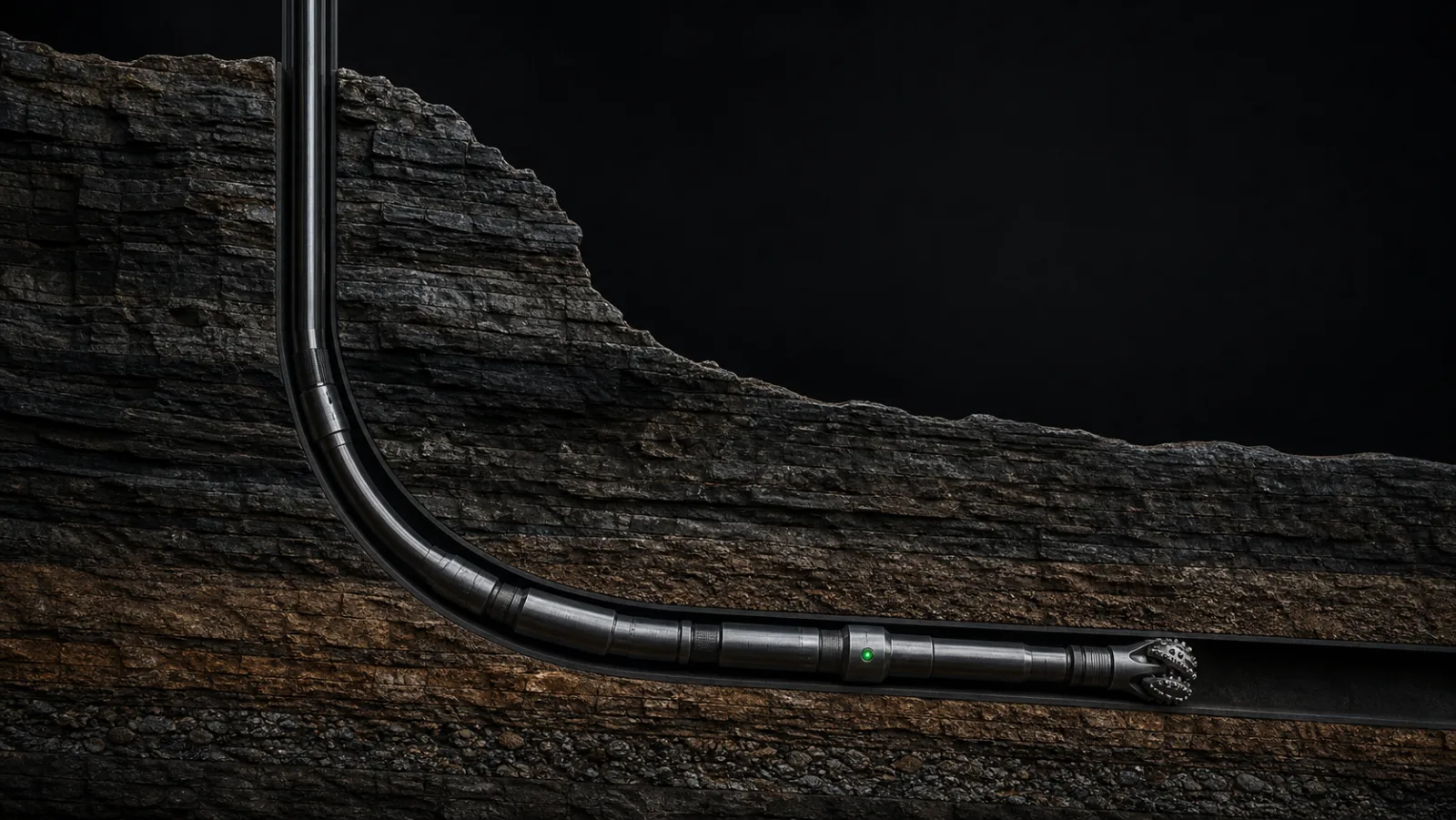
The whole assembly rotates. Deflection comes from six mud-driven hydraulic pistons — maximum force, with no external ports in the housing.
Generator powered, no batteries. Run time is not limited by a power source.
Downlink by flow rate change. Automatic hold of inclination and azimuth.
RT-Link channel: real-time exchange with MWD on an open platform compatible with systems from different manufacturers. It carries inclination, azimuth, collar rotation with minimum and maximum, downlink confirmation and diagnostics — deflector fault, currents, shock levels.
Protection against dynamics: internal dampers, a frequency-tuned electronics block, components rated for fatigue loading, and filters for high lost-circulation and solids concentrations.
A universal plug-and-play control block — one set of electronics across sizes, and a short repair cycle.
How a project runs
01
Input data
Mud type and density, minimum and maximum flow rate, the make-up of the assembly, the bit, and trajectory requirements.
02
Selection
Assembly and hydraulics matched to the specific profile.
03
Site preparation
Connection to the mud logging unit for flow-rate downlink, and a stable link for remote monitoring.
04
Drilling
24/7 support: parameter control, trajectory accuracy, decisions on the fly.
05
After the run
Full teardown with photographic records, memory download and review, a written report with plots, and where needed an analysis of high-frequency records to find sticking and vibration.
06
Handover of competence
Training for your engineers and, where needed, setting up a service centre.
Why own it rather than rent it
Technological independence: the operator plans the drilling schedule, not a service contractor.
Lower sanctions exposure through regional maintenance and partial local assembly.
The repair base and spares sit next to the field; the tool does not leave the Caspian region.
Trained directional drilling personnel able to run this equipment are available on the market.
The tool costs no more than proven equivalents on the market.
Estimated payback of three years on a programme of three sets or more; the calculation is made for the specific project.
Facts
D-Tech figures
Over 3,500
commercial runs
Over 3.5 m
metres drilled
19
countries
4,877 m
longest single run
6,189 m
longest horizontal section
223 h
longest run, circulating hours
In development since 2005, in serial supply since 2015; manufacturing and R&D in Bristol, United Kingdom.
HTD
Authorised distributor of D-Tech rotary steerable systems in the Caspian region since 2022.
Own MWD systems paired with the rotary steerable.
The rotary steerable service base for the Caspian region is in Aktobe.
Common questions
Can we take the tool for a single well to see how it performs?
Yes. Drilling with our equipment and our engineers is a working scenario and the usual first step before a purchase decision.
Who maintains the tool after we buy it?
HTD, under a separate contract: repair, inspection after every run, spare part supply. At your request a service centre is set up at your base, with training for your personnel.
Which telemetry does the system work with?
The RT-Link channel is built for an open platform and is compatible with MWD from different manufacturers. Compatibility is checked while the assembly is selected.
What is needed from the rig?
A connection to the mud logging unit for flow-rate downlink and a stable internet link for remote monitoring. The rest follows the drilling programme.
Which hole sizes are covered?
From 5 7/8 to 18 1/8 inches. The specific size is matched to the section and the profile.
Technical parameters follow the D-Tech specification. The package, the crew and the scope of work are set by the profile of the specific well and fixed in the drilling programme. Data on wells drilled is published once the operator has agreed to it.
Supply, start-up and service in one contour.
The core of the business is supplying oilfield production equipment: selection against the client specification, project packaging, sourcing against the specific order, delivery to site, supervision and commissioning within an agreed scope. Both oil-producing and oilfield service companies work this way with us — wherever supply, start-up and service are easier to close in one contour than to assemble piece by piece.
What the supply covers
01
Selection
The scope is assembled from the specification and the well regime, not from a catalogue line.
02
Delivery
Sourced against the specific order and shipped to site on agreed dates, with passports and documentation.
03
Start-up
Supervision and commissioning on site — a separate line of the project, within an agreed scope.
04
Technical support
Support during operation and analysis of abnormal events on the well stock. Warranty obligations come with the supply; well-stock analytics is a separate service.
A Kazakhstan legal entity. Supply scope, schedule and site work are fixed in the specification for each project.
Who we have supplied.
Equipment we have supplied operates for international oilfield service and national oil companies.
ANSK
ABSS
Oil Engineering
Company names are listed as supply recipients. Logos remain the property of their owners and imply no partnership, endorsement or approval.
From enquiry to supply, start-up and service.
HTD Industrial is the core direction of the company: equipment for oil production. We work through the task and the specification, select the package, bring it in against the specific order and put it into operation on site. What we carry beyond that — from supervision to technical support — is fixed in the individual project.
01
Enquiry
Record the task or the nomenclature and the parameters of the asset.
02
Specification
Refine scope, schedule and requirements, and match the well regime to the equipment application envelope.
03
Commercial proposal
A proposal for the equipment or the service, with supply terms.
04
Contract and procurement
Contracting, procurement and logistics against the specific order.
05
Delivery
The package ships to site with passports and documentation.
06
Commissioning and service
Supervision, start-up and support within the contract scope.
The order and the content of the steps depend on the type of equipment and on the client procurement procedure: sometimes it is delivery and start-up on site, sometimes the full cycle with supervision and ramp-up. The sequence describes a typical project and is not a public offer.
A verifiable supplier for a technical conversation.
HTD is an international supplier and service partner in oil production: operating since 2022, with offices in five countries and supply across the CIS, MENA and the USA. The brand is built from three directions, and production equipment is the core one.
Brand directions
HTD Industrial
Production equipment
Selection, supply, start-up and service of oilfield production equipment — directional drilling included. The core direction of the company.
HTD NEO
Energy transition technologies
Developing and deploying technologies for the energy transition. The first step beyond oil and gas is lithium extraction from produced water.
HTD AI
AI inside the products
Artificial intelligence as a tool inside products for the industry rather than a separate service. The direction is being launched.
01
Start with asset data
No configuration is proposed before the regime, constraints and target metric are understood.
02
Define the application envelope
Equipment parameters are refined for the asset and fixed in the assessment.
03
Agree responsibility
Supply, supervision and support are defined by the scope of the specific project.
Challenging well stock? Start with an engineering enquiry.
Describe the challenge — HTD replies with the inputs needed for an initial assessment. You can skip the form and call or write instead.
Direct line
Email suits a technical enquiry best: field inputs, specifications and tender documents travel with the message.
HTD AI is a direction now being launched: artificial intelligence as a tool inside products for oil production rather than a separate service. Specific functions, dates and effects will be stated once there is a working product behind the words.